Why Pray for America?

Forward from the One Year Pray for America Bible

by Dr. Barry C. Black, Chaplain of the United States Senate

The One Year Pray for America Bible provides springboards for prayer that enable you to pray more effectively. It gives a different prayer prompt each day, encouraging us to pray for our government and make petitions on behalf of our leaders and fellow citizens for security, forgiveness, mercy, justice, humility, and wisdom. Prayer enables us to make our voices heard in heaven regarding America’s needs.

Prayer helped to make America a beacon of freedom. At the birth of this nation, people sought God’s help in making the dream of Liberty a reality. At the 1787 Constitutional Convention, when the participants had reached an impasse, Benjamin Franklin suggested that they pray, and they eventually did. Those prayers aided in our nation’s birth.

One of the first acts of the new American legislative branch in 1789 was to establish a chaplaincy. A key responsibility of this chaplaincy was to begin each legislative session with an invocation. Prayer has continued almost uninterrupted since that time, because seeking God’s assistance for a person, nation, or world is laudable. The Bible reminds us, “Godliness makes a nation great, but sin is a disgrace to any people” (Proverbs 14:34). Humanity can cooperate with Divinity in making a nation great.

If our nation started with prayer, perhaps we should also sustain it with the same. We should get back to praying because, after all, God is sovereign over all nations. Job 12:23-24 says this about God: “He builds up nations, and he destroys them. He expands nations, and he abandons them. He strips kings of understanding and leaves them wandering in a pathless wasteland.” These verses make it clear that humanity will not have the ultimate word in what happens to nations; God will.

Getting Back to Praying for Our Nation

We should get back to praying for our government because God has ordained government to establish order in society. The apostle Paul puts it this way:

Everyone must submit to governing authorities. For all authority comes from God, and those in positions of authority have been placed there by God. So anyone who rebels against authority is rebelling against what God has instituted, and they will be punished. For the authorities do not strike fear in people who are doing right, but in those who are doing wrong. Would you like to live without fear of the authorities? Do what is right, and they will honor you. The authorities are God’s servants, sent for your good. But if you are doing wrong, of course you should be afraid, for they have the power to punish you. They are God’s servants, sent for the very purpose of punishing those who do what is wrong. So you must submit to them, not only to avoid punishment, but also to keep a clear conscience.

Pay your taxes, too, for these same reasons. For government workers need to be paid. They are serving God in what they do. Give to everyone what you owe them: Pay your taxes and government fees to those who collect them, and give respect and honor to those who are in authority. (Romans 13:1-7)

God ordained government for our good. Paul instructs us that government officials deserve our prayers, finances, honor, and respect.

We should get back to praying for our government because God commands us to pray for it. We find these words in 1 Timothy 2:1-4, “I urge you, first of all, to pray for all people. Ask God to help them; intercede on their behalf, and give thanks for them. Pray this way for kings and all who are in authority so that we can live peaceful and quiet lives marked by godliness and dignity. This is good and pleases God our Savior, who wants everyone to be saved and to understand the truth.”

We should get back to praying for our government because life should not be divided into sacred and secular. God has sovereignty over all our lives because in him we live, move, breathe, and function (Acts 17:28). According to Proverbs 21:1, even the king’s heart is in God’s hands; the sovereign God guides the king’s heart as he desires. Our lives are sustained by a powerful divine providence, and the sacred permeates every part of our existence, including government.

We should get back to praying for our government because people of faith have a role in influencing public life and policy. We must give to Caesar what belongs to him (Matthew 22:21), fostering morality in government and holding authorities accountable. The Bible challenges us to be salt and light to our world (Matthew 5:13-16). This means refusing to be missing in action when it comes to governmental affairs. Esther, Nehemiah, and Daniel are just three examples of how believers should relate to government constructively.

We should get back to praying for our government because the ends sought by the government should be morally acceptable. In short, when Caesar’s dictates collide with God’s commands, we must obey God instead of Caesar (Acts 5:29). When the Babylonian king demanded that Daniel and his friends eat inappropriate food, Daniel negotiated an acceptable alternative that satisfied this demand (Daniel 1:5-16). When, however, the same king insisted these young men bow and worship an idol or be executed in a fiery furnace, the young men chose to risk death rather than compromise their faith (Daniel 3:1-18). Therefore, we must cooperate with government whenever it does not violate our allegiance to God and resist it when it does. Part of our cooperation entails praying.

We should get back to praying for our government because we are urged to pray for others. In Jesus’ model prayer for his disciples (Matthew 6:9‑13), the pronouns are plural. It does not say “My Father” but “Our Father.” We are not told to pray “give me today the food I need,” but “give us today the food we need.” Jesus does not admonish us to pray “don’t let me yield to temptation, but rescue me from the evil one,” but “don’t let us yield to temptation, but rescue us from the evil one.” Although some may find it difficult to believe that the effectiveness of prayer goes beyond the private and interior life of the intercessor, the Bible urges us to pray for others (James 5:16).

We should get back to praying for our government because intercessory prayer is an affirmation of faith in the God who desires to serve humanity. God says in Ezekiel 33:11: “As surely as I live, says the Sovereign Lord, I take no pleasure in the death of wicked people. I only want them to turn from their wicked ways so they can live. Turn! Turn from your wickedness, O people of Israel! Why should you die?” In his book on prayer, Eric Hayman observed, “The power of our intercession is not our isolated pressure on a God remote from us. It is the action of His Spirit in and through our little souls, self-offered to the purpose of His will. So our intercession depends on our keeping open both to the perfect will of God and also the need and suffering of the world.”* Perhaps this is why Elton Trueblood speaks of the church as a “fellowship of the concerned.”†

We should get back to praying for our government because God blesses nations that acknowledge him. Psalm 33:12 states: “What joy for the nation whose God is the Lord, whose people he has chosen as his inheritance.” God shows special favor to those who respect his sovereignty. He protects these nations, surrounding them with the shield of his love (Psalm 5:12).

How We Should Pray

So, how should we pray for our government? First, we should pray for our government’s needs. One Greek word that can be translated as “supplication”in 1 Timothy 2:1 is deēsis, which is a word that suggests that God expects us to ask him to meet our government’s needs. God has promised to supply all our needs out of his celestial bounty (Philippians 4:19). He invites us to cry out to him when we are confronted with trouble (Psalm 50:15).When our government is overwhelmed by moral, financial, and even safety concerns, we should intercede for its needs. We have an example of praying for the needs of the government in James 5:16-18. These verses remind us that Elijah prayed and asked God to stop the rain from falling. Elijah was concerned because the government under King Ahab had endorsed the worship of Baal. The government seemed certain that it was Baal who sent the rain and produced a bountiful harvest, not the God of Israel. Elijah was concerned about governmental deviation from God’s law. He wanted the sovereign God of Israel to assert himself, and God answered his prayer,which was prompted by this need.

Second, we should pray with total dependence on God. Another Greek word in 1 Timothy 2:1 that can be translated as “prayer” is proseuchē. This word suggests that we should seek God as the sole provider of our government’s success. This dependence on God’s power is implied in Psalm 127:1: “Unless the Lord builds a house, the work of the builders is wasted. Unless the Lord protects a city, guarding it with sentries will do no good.” The notion of total dependence upon God is also captured in the Ten Commandments given to Moses by God on Mount Sinai: “You must not have any other god but me” (Exodus 20:3). God desires to be our sole provider.

Third, we should pray confidently, knowing that we have complete access to God. The Greek word enteuxis in 1 Timothy 2:1 can be translated as “petition.” In this word, we can see an admonition to come boldly before God’s throne of grace to receive help in the time of need (see also Hebrews 4:16). We hear this same sentiment in 1 Peter 2:9, which describes believers as royal priests. A priest is someone who has access to both God and the people and is a bridge between God and the people. When we pray for our government, we should intercede with an awareness of our complete access to God in heaven.

Finally, we should pray with thanksgiving. The final Greek word in 1 Timothy 2:1 that shows us how to pray is eucharistia, which can be translated“thanksgiving.” Thanksgiving adds perfume to our petitions ascending to God’s throne. Philippians 4:6 says: “Pray about everything. Tell God what you need, and thank him for all he has done.” Everything includes our prayers for our government. Believers are also encouraged to give thanks in every circumstance (1 Thessalonians 5:18). Continual thanksgiving is God’swill for our lives.

The Difference Prayer Can Make

Imagine the difference our prayers would make if we asked specifically for God to deal with the needs of our nation. What would happen if we prayed for a stronger economy, or more harmonious race relations, or greater civility among our political leaders, or better cooperation between our branches of government? Specificity matters. God is waiting for us to be specific about our needs.

Imagine what would happen if we sought God as our first option—not the fourth or fifth. It would be wonderful to avoid the mistakes of the disciples in a storm at sea. They first attempted to save themselves; they waited before awakening Jesus (Mark 4:35-41). Our prayers for government can be energized by understanding that God is the sole source of our strength and help.

Imagine what would happen if we took frequent advantage of the complete access God has given us to his throne because of our status as royal priests. It can take months to meet with a government leader, but God has provided us with continuous access to his presence, mercy, grace, and might.

Imagine what would happen if Thanksgiving came every day instead of once a year. How much more effective our prayers would be if we decided with the psalmist to praise the Lord at all times, with his praises constantly on our lips (Psalm 34:1). Perhaps then we would know experientially the truth of Psalm 22:22-31, which envisions a holy God who is continually praised by his people. The greatest days of our nation are linked to the holiness of its citizens. By God’s grace, let’s get back to prayer. The One Year Pray for America Bible is a great starting point.

* Eric Hayman, Prayer and the Christian Life (London: Student Christian MovementPress, 1948), 122-123.

† Elton Trueblood, Alternative to Futility (New York: Harper and Brothers, 1948), 58.

Sampler One Year Pray for America Bible
Look Inside the One Year Pray for America Bible

The Transformational Simplicity of the Whole Bible in One Year

What are some first impressions of the Bible? It’s a big book. It seems overwhelming. It’s filled with people and places that seem different than us and our surroundings. If we take a closer look and actually get into its pages, we discover it’s extremely personal, and the people and places actually look a lot more familiar to us than they did at first glance. But what about the overwhelming part? It can be hard to know where to begin or how everything is connected.

The One Year Bible is a great resource to help us engage with the Bible in a manageable way. It takes the entire Bible and breaks it down into daily readings. It sounds so simple, and yet it’s transformational. From seekers to life-long believers, The One Year Bible has helped people understand God’s story and what it means to each of us.

Dishy was not a Christian when he started reading the Bible. He questioned its validity and wondered why people would believe it’s true.

“I have spent much of my life wondering whether any of Christianity’s teachings were true or just wishful thinking, and perhaps also a good sales job perpetuated by ancient people with an agenda. But it’s quite easy to have an uneducated opinion about something you vaguely know about but haven’t actually read! So, I decided to start putting forth an effort to read the actual Bible, the whole thing, from beginning to end. I hoped that this exercise would put the issue to rest in my life and I would be able to decide once and for all what I thought about Christianity,” he said.

To do this he selected The One Year Bible and an NLT Study Bible to help him go to deeper into the context and meaning.

“I really like the read-it-in-one-year concept with scheduled daily passages. It is helpful to refer to a study Bible to occasionally get more background and explanation. This One Year Bible encourages me to keep up with it. Since the passages aren’t very long each day, I think Surely I can read this for 10 or 15 minutes. So, whoever thought of the concept had a really great idea.”

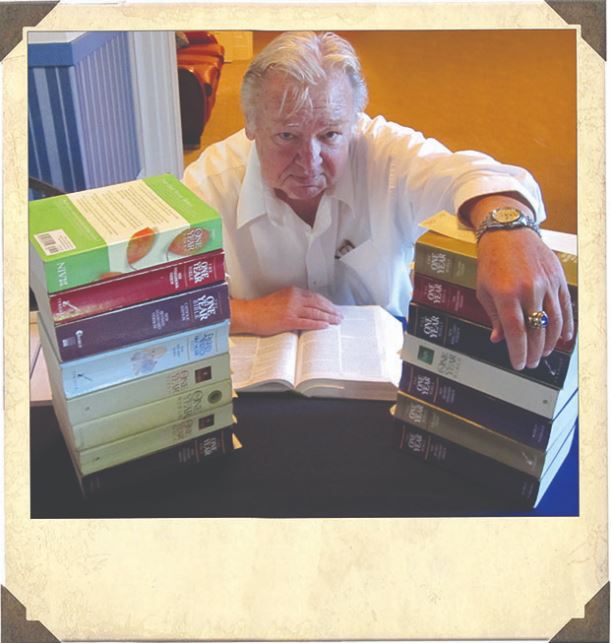
Is this still a good Bible for people who have been reading it most of their lives? Hank thinks so. He is a lifelong Christian and has read the Bible every day for almost 30 years.

“I love the Bible. It’s such a joy to read it, and I just want everyone to have that joy and understand what it can give you,” said Hank.

He started with his family.

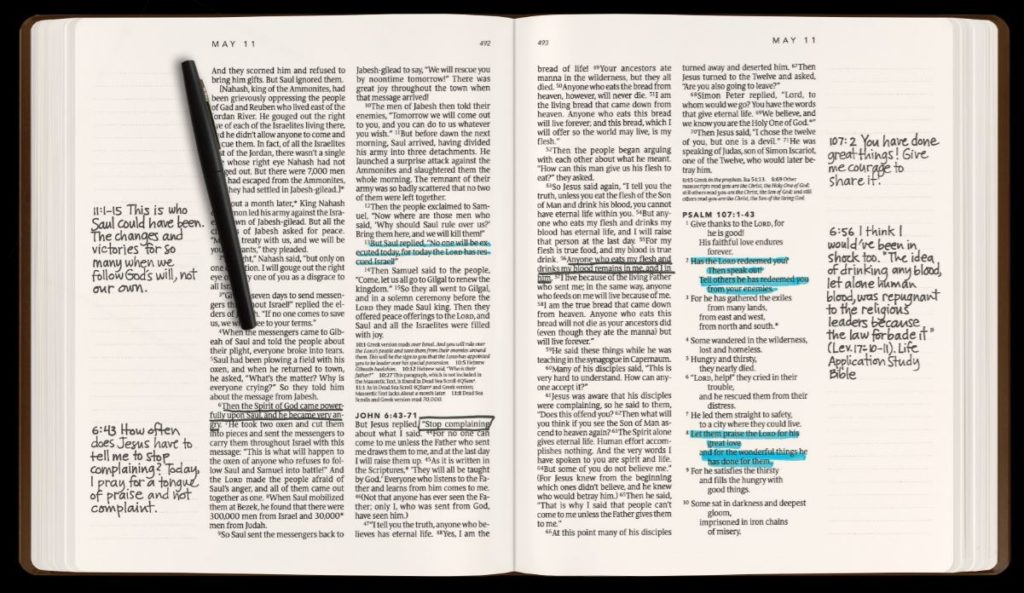
“For 19 years I read a One Year Bible, and each year I dedicated it to a family member. The notes in the margin were personal, such as ‘This is my prayer for you.’ I’ve underlined, circled, and highlighted many passages, letting them know what inspires me. It is my legacy to them,” said Hank.

Through these Bibles Hank has inspired a love for God’s Word in others. Sharing his struggles, joys, failures, and triumphs as he moves closer to God has been a comfort and a catalyst for his family members to grow deeper in their understanding of God through his Word.

“When I give it to them and they read it, they always come back saying, ‘I didn’t know you were going through that’ or ‘when you wrote this it helped me to better understand what I was facing.’ The Bible gives me joy whenever I read it, and I get joy by sharing it with others. The more you get into it, the more your joy will grow,” said Hank.

One Year Bible
Take a Look Inside
The One Year Bible

One Year Pray for America Bible

Reading from May 7th in the One Year Pray for America Bible

Lord, Hannah understood exactly who you are. When she prayed, “No one is holy like the Lord! There is no one besides you,” she nailed it (1 Samuel 2:2). May all who search for you—the powerful and the humble— recognize who you really are! Amen.

Prayer Prompt

1 SAMUEL 1:1–2:21
There was a man named Elkanah who lived in Ramah in the region of Zuph in the hill country of Ephraim. He was the son of Jeroham, son of Elihu, son of Tohu, son of Zuph, of Ephraim. Elkanah had two wives, Hannah and Peninnah. Peninnah had children, but Hannah did not.

Each year Elkanah would travel to Shiloh to worship and sacrifice to the Lord of Heaven’s Armies at the Tabernacle. The priests of the Lord at that time were the two sons of Eli—Hophni and Phinehas. On the days Elkanah presented his sacrifice, he would give portions of the meat to Peninnah and each of her children. And though he loved Hannah, he would give her only one choice portion because the Lord had given her no children. So Peninnah would taunt Hannah and make fun of her because the Lord had kept her from having children. Year after year it was the same—Peninnah would taunt Hannah as they went to the Tabernacle. Each time, Hannah would be reduced to tears and would not even eat.

“Why are you crying, Hannah?” Elkanah would ask. “Why aren’t you eating? Why be downhearted just because you have no children? You have
me—isn’t that better than having ten sons?”

Once after a sacrificial meal at Shiloh, Hannah got up and went to pray. Eli the priest was sitting at his customary place beside the entrance of the Tabernacle. Hannah was in deep anguish, crying bitterly as she prayed to the Lord. And she made this vow: “O Lord of Heaven’s Armies, if you will look upon my sorrow and answer my prayer and give me a son, then I will give him back to you. He will be yours for his entire lifetime, and as a sign that he has been dedicated to the Lord, his hair will never be cut.”

As she was praying to the Lord, Eli watched her. Seeing her lips moving but hearing no sound, he thought she had been drinking. “Must you come here drunk?” he demanded. “Throw away your wine!”

“Oh no, sir!” she replied. “I haven’t been drinking wine or anything stronger. But I am very discouraged, and I was pouring out my heart to the Lord. Don’t think I am a wicked woman! For I have been praying out of great anguish and sorrow.”

“In that case,” Eli said, “go in peace! May the God of Israel grant the request you have asked of him.”

“Oh, thank you, sir!” she exclaimed. Then she went back and began to eat again, and she was no longer sad.

The entire family got up early the next morning and went to worship the Lord once more. Then they returned home to Ramah. When Elkanah slept with Hannah, the Lord remembered her plea, and in due time she gave birth to a son. She named him Samuel, for she said, “I asked the Lord for him.”

The next year Elkanah and his family went on their annual trip to offer a sacrifice to the Lord and to keep his vow. But Hannah did not go. She told her husband, “Wait until the boy is weaned. Then I will take him to the Tabernacle and leave him there with the Lord permanently.”

“Whatever you think is best,” Elkanah agreed. “Stay here for now, and may the Lord help you keep your promise.” So she stayed home and nursed the boy until he was weaned. Hannah took him to the Tabernacle in Shiloh. They brought along a three-​year-​old bull for the sacrifice and a basket of flour and some wine. After sacrificing the bull, they brought the boy to Eli. “Sir, do you remember me?” Hannah asked. “I am the very woman who stood here several years ago praying to the Lord. I asked the Lord to give me this boy, and he has granted my request. Now I am giving him to the Lord, and he will belong to the Lord his whole life.” And they worshiped the Lord there.

Then Hannah prayed:
“My heart rejoices in the Lord!
The Lord has made me strong.
Now I have an answer for my enemies;
I rejoice because you
rescued me.
No one is holy like the Lord!
There is no one besides you;
there is no Rock like our God.
“Stop acting so proud and haughty!
Don’t speak with such arrogance!
For the Lord is a God who knows what you have done;
he will judge your actions. The bow of the mighty is now broken,
and those who stumbled are now strong.
Those who were well fed are now starving, and those who were starving are now full.
The childless woman now has seven children,
and the woman with many children wastes away.
The Lord gives both death and life;
he brings some down to the grave but raises others up.
The Lord makes some poor and others rich;
he brings some down and lifts others up.
He lifts the poor from the dust and the needy from the garbage dump.
He sets them among princes,
placing them in seats of honor.
For all the earth is the Lord’s,
and he has set the world in order.

“He will protect his faithful ones,
but the wicked will disappear in darkness.
No one will succeed by strength alone.
Those who fight against the Lord will be shattered.
He thunders against them from heaven;
the Lord judges throughout the earth.
He gives power to his king;
he increases the strength of his anointed one.”

Then Elkanah returned home to Ramah without Samuel. And the boy served the Lord by assisting Eli the priest.

Now the sons of Eli were scoundrels who had no respect for the Lord or for their duties as priests. Whenever anyone offered a sacrifice, Eli’s sons would send over a servant with a three-​pronged fork. While the meat of the sacrificed animal was still boiling, the servant would stick the fork into the pot and demand that whatever it brought up be given to Eli’s sons. All the Israelites who came to worship at Shiloh were treated this way. Sometimes the servant would come even before the animal’s fat had been burned on the altar. He would demand raw meat before it had been boiled so that it could be used for roasting.

The man offering the sacrifice might reply, “Take as much as you want, but the fat must be burned first.” Then the servant would demand, “No, give it to me now, or I’ll take it by force.” So the sin of these young men was very serious in the Lord’s sight, for they treated the Lord’s offerings with contempt.

But Samuel, though he was only a boy, served the Lord. He wore a linen garment like that of a priest. Each year his mother made a small coat for him and brought it to him when she came with her husband for the sacrifice. Before they returned home, Eli would bless Elkanah and his wife and say, “May the Lord give you other children to take the place of this one she gave to the Lord.” And the Lord blessed Hannah, and she conceived and gave birth to three sons and two daughters. Meanwhile, Samuel grew up in the presence of the Lord.

JOHN 5:1-23
Afterward Jesus returned to Jerusalem for one of the Jewish holy days. Inside the city, near the Sheep Gate, was the pool of Bethesda, with five covered porches. Crowds of sick people—blind,lame, or paralyzed—lay on the porches. One of the men lying there had been sick for thirty-​eight years. When Jesus saw him and knew he had been ill for a long time, he asked him, “Would you like to get well?”

“I can’t, sir,” the sick man said, “for I have no one to put me into the pool when the water bubbles up. Someone else always gets there ahead of me.” Jesus told him, “Stand up, pick up your mat, and walk!” Instantly, the man was healed! He rolled up his sleeping mat and began walking! But this miracle happened on the Sabbath, so the Jewish leaders objected. They said to the man who was cured, “You can’t work on the Sabbath! The law doesn’t allow you to carry that sleeping mat!”

But he replied, “The man who healed me told me, ‘Pick up your mat and walk.’”

“Who said such a thing as that?” they demanded.

The man didn’t know, for Jesus had disappeared into the crowd. But afterward Jesus found him in the Temple and told him, “Now you are well; so stop sinning, or something even worse may happen to you.” Then the man went and told the Jewish leaders that it was Jesus who had healed him. So the Jewish leaders began harassing Jesus for breaking the Sabbath rules. But Jesus replied, “My Father is always working, and so am I.” So the Jewish leaders tried all the harder to find a way to kill him. For he not only broke the Sabbath, he called God his Father, thereby making himself equal with God.

So Jesus explained, “I tell you the truth, the Son can do nothing by himself. He does only what he sees the Father doing. Whatever the Father does, the Son also does. For the Father loves the Son and shows him everything he is doing. In fact, the Father will show him how to do even greater works than healing this man. Then you will truly be astonished. For just as the Father gives life to those he raises from the dead, so the Son gives life to anyone he wants. In addition, the Father judges no one. Instead, he has given the Son absolute authority to judge, so that everyone will honor the Son, just as they honor the Father. Anyone who does not honor the Son is certainly not honoring the Father who sent him.”

PSALM 105:37-45
The Lord brought his people out of Egypt, loaded with silver and gold;
and not one among the tribes of Israel even stumbled.
Egypt was glad when they were gone,
For they feared them greatly.
The Lord spread a cloud above them as a covering
and gave them a great fire to light the darkness.
They asked for meat, and he sent them quail;
he satisfied their hunger with manna—bread from heaven.
He split open a rock, and water gushed out
to form a river through the dry wasteland.
For he remembered his sacred promise
to his servant Abraham.
So he brought his people out of Egypt with joy,
his chosen ones with rejoicing.
He gave his people the lands of pagan nations,
and they harvested crops that others had planted.
All this happened so they would follow his decrees
and obey his instructions.
Praise the Lord!

PROVERBS 14:28-29
A growing population is a king’s glory;
a prince without subjects has nothing.
People with understanding control their anger;
a hot temper shows great foolishness.

Want to read more? The December 2019 Read With Us plan is featuring the One Year Pray for America Bible. Every week you will receive links to the reading for the each day of the week. Sign up and join us.

Sampler One Year Pray for America Bible
Look Inside the
One Year Pray for America Bible

God of Your Story

365 days from now you will look in the mirror and see a better person—if you will show up every day. The choices you make over the next 365 days will determine the story of your year.

Use the daily readings from The God of Your Story in conjunction with the One Year Bible to enjoy and appreciate the entire Bible without getting lost—and, perhaps for the first time, to hear the Bible speak to you on its own behalf. You may be surprised to discover that the God of the Bible is also the God of your story! Will you find Him where He’s speaking?

Make the Bible a daily decision. The adventure awaits.

Watch this video and hear from from Brian about his journey beginning with the One Year Bible to becoming the author of the God of Your Story.

Brian is the leader of the Daily Audio Bible podcast. Subscribe for daily readings from the One Year Bible.

One Year, One Book—One Exciting Journey

by Kim Adetunji, brand manager

As the year winds down and a new year is on the horizon, many people begin reflecting on the previous year and making plans for the new one. Our thoughts may return to the highlights and lowlights of the year we are in as well as remembering God’s faithfulness and the lessons we learned. We then turn to our goals and aspirations for the new year, the things we want to get right this year and the things we want to keep—or start—doing. The new year holds so much hope and promise, especially when the current year has been a difficult one. It’s a brand new beginning—365 days to pursue God, become more like Christ, rest in his presence, listen for his voice, and follow where he leads. It’s exciting to think of the possibilities that lie ahead.

Will the new year hold new friendships, a new job, or new opportunities? Will we finally reach that goal we’ve been striving for? Will our long-time prayers for a spouse or healing or a mended relationship or a different heartache finally be answered? Will our trust in God grow deeper than we ever thought possible? Will our hard hearts soften? Will we experience joy once again? Will we finally be able to put aside that fear, anger, resentment, disbelief, or “you name it” that is holding us back from trusting God fully? Will we surrender new areas of our lives to God? In what ways will God stretch us beyond what we think we are capable of? Will we sense God’s deep, unconditional love anew? Who will we share the Good News with this year?

We may even think about new ways we’d like to grow spiritually, whether it’s growing more patient with our spouse or kids or letting the peace of Christ rule more fully in our hearts. How could we move toward God’s plan for us rather than shrinking away from where we hear God calling us to. What are new ways to step out into obedience this year? How can we slow down our schedule just a little bit more to create space to listen for God’s gentle whisper? What truths from Scripture have I dismissed? How can I give God my very best each day? Do I dedicate enough of my day to those things that draw me closer to God and allow me to hear his voice? Am I following through on God’s promptings? Am I open to allowing God to challenge me in a new area?

Do you plan to track your prayers in the new year? the ways you intentionally follow God’s lead? your service projects and how God expands your heart through those experiences? the ways you’ve seen God’s faithfulness in your life? answered prayers? words from him? verses you’ve memorized? There are so many unique ways to track our spiritual growth and keep focused on our goal to pursue and honor God. Each of us is unique, and there is no one right way to do it. If you’re like me, you may be constantly seeking new ways to become more efficient with recording and tracking everything that is meaningful—all in one place.

As the new year approaches, you may search for a new journal, notebook, daily planner, or app to help you organize your year and capture all the memories, highlights, and learnings. Journaling Bibles are a great way to capture all that God is doing in your life in one place. There are two One Year Bible journaling editions—Expressions and Reflections—that give you a daily reading plus space in the wide margins alongside each day’s reading to reflect on the passage you’ve read, write notes or journal entries, keep track of highlights from your day, or archive mementos or pictures. It’s a very practical way to document God-sightings in your life while being intentional about reading God’s Word daily.

Many people have been doing this, where their Bible becomes a treasured keepsake with 365 days’ worth of investment in knowing and following God, including observations from his Word and practical applications. The One Year Bible readings offer a portion from the Old Testament, the New Testament, Psalms, and Proverbs for each day. It is organized so you’ll finish the Bible in one year with the investment of just 15 minutes a day. At the end of the year, you will have an incredible collection of highlights, milestones, and so much more to look back on in your Bible as you look toward the new year.

Check out the One Year Expressions Bibles

Check out the One Year Chronological Expressions Bibles

Check out the One Year Reflections Bibles

Going beyond Genetics—Leaving a Legacy of Faith

A recent popular trend is ancestry kits. People want to know their heritage—where they came from and who they are. Throughout the Bible we see the importance of lineage. Slugging through those difficult names can seem like a burden, but the point is that each of those names has a story. It is a lineage of choices, mistakes, triumphs, joys, and sorrows.

Through Christ we are part of God’s lineage of grace. We can pass on more than just DNA to the next generation. We can leave a legacy of faith. That’s what our friend Hank is doing.

Each year he chooses a different family member and reads through a One Year Bible, making specific notes and sharing personal insights that he felt God calling him to share with that loved one. Is there a more beautiful gift than a legacy of faith and love?

“For 19 years I read a One Year Bible, and each year I dedicated it to a family member to be given to them when I die. The notes in the margin were personal, such as ‘This is my prayer for you.’ I’ve underlined,circled, and highlighted many passages, letting them know what inspires me. It is my legacy to them.” – Hank Snyder

What notes, reflections, inspirations, and prayers would you share with your loved one? What has helped guide you through God’s Word?

Look inside the OneYear Reflections Bible