August 19, 2026
What Does the Bible Say About Identity? 13 Verses from the New Living Translation (NLT)
What Does the Bible Say About Identity? 13 Verses from the New Living Translation (NLT)

“Do you know who you are when you walk into a room, or do you become whoever you think the room needs you to be?”
Beyond our names, our favorite colors, and the sound of our laughter, one of the most defining features of us is a question we often ask ourselves: Who am I?
In Ecclesiastes 3:11, Scripture suggests we are wired for this question by saying that God “has planted eternity in the human heart.” For many, this restlessness shows us as weariness when we tire of pretending and begin longing for a more authentic identity.
In her upcoming book, Into the Deep, Angie Smith writes, “Sometimes God allows us to reach the end of our ability to maintain the façade. The very thing we’ve been running from—being found out, being seen as we really are—becomes the doorway to freedom” (20).
The following Bible verses remind us of the story of who we are: why God created mankind, how we first betrayed his grace, and the ways in which he has redeemed us through Christ, ultimately redefining our identity as sinners to those who are redeemed.
Read until the end for a powerful excerpt from Angie Smith.
Genesis 1:27
So God created human beings in his own image. In the image of God, he created them; male and female he created them.
Psalm 139:13-14
You made all the delicate, inner parts of my body and knit me together in my mother’s womb. Thank you for making me so wonderfully complex! Your workmanship is marvelous—how well I know it.
Romans 5:12
When Adam sinned, sin entered the world. Adam’s sin brought death, so death spread to everyone, for everyone sinned.
1 John 1:8
If we claim we have no sin, we are only fooling ourselves and not living in the truth.
1 Peter 1:18-19
“For you know that God paid a ransom to save you from the empty life you inherited from your ancestors. And it was not paid with mere gold or silver, which lose their value. It was the precious blood of Christ, the sinless, spotless Lamb of God.
2 Corinthians 5:17*
Anyone who belongs to Christ has become a new person. The old life is gone; a new life has begun!
*Study Note: Life Application Study Bible: note for 2 Corinthians 5:17
When we pledge our faith to Jesus Christ, we become brand-new people on the inside. The Holy Spirit gives us new life, and we are not the same people anymore. We are not reformed, rehabilitated, or reeducated—we are re-created, new creations living in vital union with Christ (Colossians 2:6-7). At conversion we do not merely turn over a new leaf; we begin a new life under a new master. While each individual becomes a new person, Paul is implying that much more actually occurs. Not only are believers changed from within, but a whole new order of creative power begins with Christ. We have a new covenant, a new perspective, a new spirit, a new community. We are not experiencing a superficial change that will quickly fade away. We are able to see an entirely new order of all creation under Christ’s authority. It requires a new way of looking at all people and all of creation. Does your life reflect this new perspective?
Ephesians 2:10
For we are God’s masterpiece. He has created us anew in Christ Jesus, so we can do the good things he planned for us long ago.
Isaiah 43:1
But now, O Jacob, listen to the Lord who created you.
O Israel, the one who formed you says,
“Do not be afraid, for I have ransomed you.
I have called you by name; you are mine.”
1 Corinthians 12:27*
All of you together are Christ’s body, and each of you is a part of it.
*Study Note: Life Application Study Bible: note for 1 Corinthians 12:27
What is your response when a fellow Christian is honored? How do you respond when someone is suffering? We are called to be happy with those who are happy and to suffer with those who suffer (Romans 12:15). Too often, unfortunately, we are jealous of those who are happy and apathetic toward those who suffer. It’s hard to rejoice when someone else is honored or blessed, especially if we think we deserve it. And it’s hard to empathize with those who are struggling, especially if we think they deserve it. But believers are in the world together—there is no such thing as private or individualistic Christianity. Each of us needs to get involved in the lives of others and not just enjoy our own relationship with God.
Ephesians 1:4
Even before he made the world, God loved us and chose us in Christ to be holy and without fault in his eyes.
1 John 3:1
See how very much our Father loves us, for he calls us his children, and that is what we are! But the people who belong to this world don’t recognize that we are God’s children because they don’t know him.
Luke 12:7*
“And the very hairs on your head are all numbered. So don’t be afraid; you are more valuable to God than a whole flock of sparrows.”
*Study Note: Life Application Study Bible: note for Luke 12:7
God’s estimate of our worth, not our peers’ estimate of it, determines our real value. Other people may evaluate and categorize us according to how we perform, what we achieve, and how we look. But God values us because he created every one of us in his image, and he is constantly working to carry out his purpose and plan for us. He doesn’t want us to miss out on all he created us to be and become.
Isaiah 64:8
“And yet, O Lord, you are our Father.
We are the clay, and you are the potter.
We all are formed by your hand.”
Into the Deep
By Angie Smith
Do you know who you are when you walk into a room, or do you become whoever you think the room needs you to be?
I wish I could sit with you and ask you who you are when no one is watching. Not what you do or how you perform or what roles you fill, but who you are in the quiet moments when the world isn’t asking anything of you. I wonder if you would say that you are most yourself when you serve others, make them happy, back down when you need to, stand up when you have to, or make them proud through accomplishments. As believers, we know the true story: We are beloved children of God, created in His image, chosen and known.
And yet we can’t dismiss the fact that the world wants us to build our identity everywhere else.
Some people are solid in their identity—they know who they are regardless of context. They don’t shift and shape themselves based on who’s watching. They carry the same sense of self from room to room, relationship to relationship.
For others, identity feels fluid and fragmented—they become different versions of themselves depending on who they’re with and what they think is expected of them. They’ve learned to read the room and adapt, to perform whatever version of themselves seems safest or most useful in the moment.
The difference isn’t confidence or social skills—it’s whether you believe you have permission to be the same person everywhere or whether you’ve learned that survival requires constant adaptation to external expectations.
People who feel permission to be consistent no matter the context operate from a foundation of secure identity. They believe they belong simply because they exist, and they don’t see their authentic self as something that needs justification.
People who feel they must constantly adapt operate from fractured identity—they believe their true self is contingent on context, that who they really are might not be acceptable, so they live with constant low-level anxiety about which version of themselves to present.
This isn’t about arrogance versus humility. Someone can be deeply humble and still carry the same sense of self everywhere.
Do you assume that the invitation is genuine or that you were invited out of obligation? Do you assume that people want to hear what you have to say or that you should keep quiet? Do you assume that you can be yourself or that you need to become someone else to fit in?
Your answer to the identity question shapes everything: how you enter rooms, navigate relationships, respond to conflict, handle success and failure. It’s the lens you use to decide which version of yourself to present in every social interaction.
As kids, our brains weren’t sophisticated enough to separate rejection from identity, so the two bled together. When a child experiences rejection—not being picked for a team, being laughed at during a presentation, being excluded from a birthday party, or targeted by a cruel “joke”—their developing brain draws the wrong conclusion. Instead of thinking, That person
was unkind or That situation was unfair, they think, Who I am isn’t safe here.
This creates the identity wound—not the rejection itself, but the story you tell yourself about whether your true self is acceptable. Your brain tries to make sense of it with a narrative that says who you really are isn’t wanted, doesn’t fit—that you need to become someone else to belong.
When you’re braced for identity rejection, you’re unable to be present as yourself. The assumption that who you really are isn’t welcome makes genuine connection difficult—you perform instead of simply being yourself. You manage your persona instead of offering your authentic self.
If you find yourself wrestling with which identity to show up with in any given situation, it isn’t easy to unlearn these lessons, but it’s never too late.
The Identity Check: Before entering a situation, ask yourself, Who am I here? If the answer is different from who you are at home or with your closest friend, pause. You don’t have to perform a different version of yourself to belong.
The Authentic Contribution: Instead of asking, What do they want from me? Ask, What do I have to offer as myself? Your genuine personality, perspective, and presence are the contribution—not some curated version you think other people would prefer.
Permission to Be Consistent: You don’t have to become more outgoing for extroverts or more serious for formal settings. Adapting your behavior is different from changing your identity. You can be appropriately respectful while remaining fundamentally yourself.
The Identity Anchor: Instead of waiting to feel safe to be yourself, start being yourself and let the safety catch up. Speak in your natural voice, share your actual thoughts, exist authentically in the space. Identity is often discovered through consistency, not performance.
There will be days when all the tools in the world feel too heavy to pick up. Days when showing up as yourself feels impossible and when staying true to your identity seems like pretending. On those days, you don’t need more strategies—you need permission.
Permission to take up space: You don’t have to shrink yourself to make others comfortable. Your presence is not an imposition. You were created to occupy space in this world—stop apologizing for existing fully.
Permission to be imperfect: Your identity isn’t contingent on your performance. You can mess up and still be yourself. Mistakes don’t disqualify you from authenticity—they qualify you for grace.
Your identity isn’t something you achieve—it’s something you remember.
What would your life look like if you truly walked in the identity that Jesus has bestowed upon you through His wild love? You may find that you don’t need to perform anymore, and when that happens, the rest of the world takes note.
Into the Deep: Finding Relief from Pressure, Exhaustion, and the Need to Perform in a Shallow World by Angie Smith, PhD, releasing in October 2026 from Tyndale House Publishers
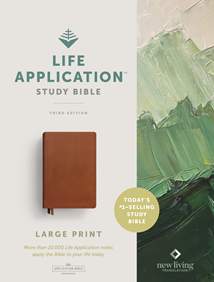
Dig deeper into more verses with the New Living Translation and the Life Application Study Bible notes.>
A team of over 100 leading biblical scholars meticulously translated the best Hebrew, Greek, and Aramaic texts into the contemporary English of the New Living Translation (NLT), blending the highest accuracy with exceptional clarity. The result is the accurate, understandable, and audibly enjoyable Bible translation that you can trust and easily apply to your life. Learn more on the official NLT website: NewLivingTranslation.com.