




May 24, 2019
Turkey’s Dangerous Game
Turkey’s Dangerous Game

Currently, all the eyes that are directed toward the Middle East seem to be focused on Iran, Saudi Arabia, and the United States’ presence in the Persian Gulf. And rightly so. The Houthis, a group of Iran-backed Yemeni rebel terrorists, have recently blown holes in two Saudi Arabian oil tankers (along with two other ships)[1] and launched a drone attack that damaged two oil pumping stations.[2] In response, the United States has shifted the Lincoln Carrier Strike Group and a bomber group to the Gulf region.[3] Tensions continue to rise and prayers for peace are needed.
Yet, even with all the attention focused on the Persian Gulf, we cannot afford to take our eyes off President Recep Tayyip Erdogan of Turkey. Recently, the Foundation for Defense of Democracies website posted an article titled “Trump Can’t Afford to Go Soft on Turkey” by Eric S. Edelman and Jonathan Schanzer. Their piece details the threat that this world leader poses to the United States and, more specifically, to its military.[4] With each passing year, this authoritarian leader is becoming more of a threat to his own country and to the world. Internally, he rules with an iron fist. With complete control over the nation’s media, the Erdogan government is the world’s top jailer of journalists.[5] Internationally, Turkey has forged ever-growing ties to both Russia and Iran. Now, he’s playing a dangerous game with President Donald Trump.
Two years ago, Trump signed into law the Countering America’s Adversaries Through Sanctions Act (CAATSA). One part of this new legislation promises sanctions on any nation that “engages in a significant transaction with . . . defense or intelligence sectors of the Government of the Russian Federation.”[6] Within four months of the signing, Turkey had ordered an advanced Russian air-defense system.[7] The danger of this defiant move is greater than the simple fact of Turkey thumbing their noses at one of their NATO allies. It’s also greater than the danger of having one of the world’s most powerful air defense systems in Turkish hands.
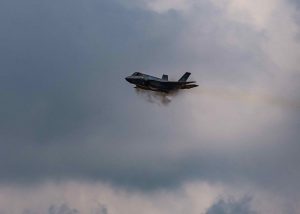
To discover the greatest risk one needs to look not in Ankara or the Middle East, but in Arizona. This is where Turkish pilots are being trained to fly the F-35 fighter jet in preparation for a purchase of these American planes by Turkey’s military.[8] The concern is that once these jets are in Turkish hands, the technology of these cutting-edge war machines can be reverse-engineered by the Russians. This would give Putin’s military a significant opportunity to increase the effectiveness of Russian air defenses against American air attack.[9] Who’s to say that this knowledge would remain in Russian and Turkish hands? It’s not hard to imagine a situation in which North Korea, Iran, and many other enemies of the United States could end up with technological information that could counter American air power and put military lives at great risk.
On April 1, the U.S. put the brakes on the sale of the jets, but Erdogan’s government believes this action is only temporary. They are betting that President Trump, in his desire for more favorable relations with Turkey and to help draw Erdogan away from Russia and Iran, will back down and move forward with the sale.[10] This would be a huge mistake. The Turkish president cannot be trusted. He has proven over and over that his involvement in NATO is a marriage of convenience at best. The best option is for President Trump, Congress, and the Pentagon to stand up against Erdogan. The language of strength is the only one the Turkish dictator understands, and the only one that must be spoken until Turkey distances herself from Russia and comes back in line with her NATO allies.
[1] CBS Evening News. “NEW: Iran or Iranian-Backed Proxies Used Explosives to Blow Holes in Four Ships—Two Saudi Oil Tankers and Two Others—near the Strait of Hormuz, According to an Initial Assessment of the U.S. Team Sent to Investigate, @CBSDavidMartin Confirms.” Twitter, 13 May 2019, twitter.com/cbseveningnews/status/1128063926120472576?s=21.
[2] Associated Press, and Reuters. “Saudi Arabia Says an Oil Pipeline Was Attacked by Explosive-Laden Drones.” Haaretz.com, 15 May 2019, www.haaretz.com/middle-east-news/houthi-run-tv-says-yemeni-group-targeted-vital-saudi-installations-1.7239285.
[3] Burns, Robert, et al. “Lincoln Carrier Strike Group, Other Resources Dispatched to Middle East over Unspecified Iran Threats.” Military Times, 6 May 2019, www.militarytimes.com/news/your-military/2019/05/06/lincoln-carrier-strike-group-other-resources-dispatched-to-middle-east-due-to-possible-attack-on-us-forces-source-says/.
[4] Edelman, Eric S, and Jonathan Schanzer. “Trump Can’t Afford to Go Soft on Turkey.” FDD, 15 May 2019, www.fdd.org/analysis/2019/05/15/trump-cant-afford-to-go-soft-on-turkey/.
[5] Ibid.
[6] Ibid.
[7] Ibid.
[8] Ibid.
[9] Ibid.
[10] Ibid.
