




Russia’s Massive War Games
Russia’s Massive War Games
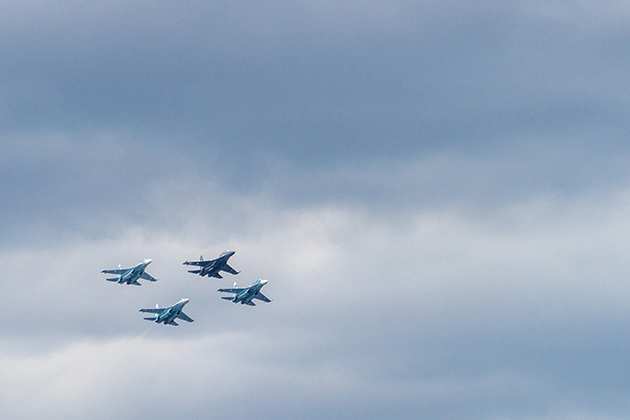
Russia has just completed its biggest round of war games since the Cold War. Called Vostok-2018, these exercises included 300,000 troops, more than 1,000 aircraft, and the ships from two naval fleets.[i] Their location is revealed in their name—vostok, which means east. Because this “friendly invasion” occurred in Siberia and in the waters off the eastern coast of Russia, China and Mongolia were invited to be participants, albeit on a much smaller level.[ii]
While these exercises certainly made the world sit up and take notice, Kremlin spokesman Demitry Peskov says they were completely warranted, considering the “aggressive and unfriendly” mood his country has recently been experiencing from the West.[iii] If this is truly just Vladimir Putin flexing his muscles to show he can’t be pushed around, he certainly struck quite the pose. The last time Russia put forth this kind of display was in 1981, but even then there were less than half the number of troops utilized.
Should the West be worried about immediate ramifications from these exercises? Likely not. But we should keep our eyes wide open. Russia has a history of using war games to mask invasions—a fact that forms the basis for my next novel, The Persian Gamble. Back in August 2008, Russia’s 58th Army conducted the Kavkaz 2008 military exercises just north of the Georgian border. Very soon after, that same army moved south and invaded the country.[iv]
In 2013–14, Russia executed a plan that was straight out of an NFL playbook. Like the coach who runs the ball four consecutive first downs, then fires it downfield the fifth, Vladimir Putin launched his own deception strategy. In 2013, he began a series of snap exercises—military maneuvers that had no notice or warning. When the first one took place, everyone scrambled to figure out what was going on, only to learn that it was just war games. Then the second occurred, and again the worry was quickly set aside when everyone saw it was just Putin out enjoying a little military practice. By the time the third and fourth had been run, no one was paying them much mind. So when the fifth dropped a large force into Crimea at the end of February 2014, everyone was caught flat-footed when Putin decided that this time he would stay and annex the region.[v]
Because the Vostok 2018 war games took place in the east, there wasn’t much concern that they were a masquerading invasion force. If they become a habit, then NATO will have to wonder if Putin is setting something up. What’s of most interest in the long term, however, is the cooperation in these exercises between Russia and China. Independently, they are already strong. Together, they are a powerhouse. The United States and the West will be wise to keep their eyes on the growing friendship and military partnership of these two nations.
[i] Perring, Rebecca. “WW3 Fears as Russia Holds HUGE ‘INVASION’ War Game—Biggest Exercise since COLD WAR.” Express.co.uk, 15 Sept. 2018, www.express.co.uk/news/world/1018071/russia-news-russia-war-world-war-3-putin-news-sea-of-japan
[ii] “Russia War Games: Biggest since Cold War ‘Justified’.” BBC News, BBC, 28 Aug. 2018, www.bbc.com/news/world-europe-45330161
[iii] Ibid.
[iv] Kowalik, Tomasz K., and Dominik P. Jankowski. “Zapad 2017: NATO Should Be Keeping an Eye on Russia’s Training Exercises.” The National Interest, Center for the National Interest, 9 May 2017, nationalinterest.org/feature/zapad-2017-nato-should-be-keeping-eye-russias-training-20540
[v] Ibid.
