




May 13, 2019
Never Again
Never Again
Markus Jakubovic weighed 65 lbs. Markus Jakubovic was 19 years old.
Ebensee, a concentration camp outside of Salzburg, Austria, was liberated on May 6, 1945—74 years ago to the day that I’m writing this. Inside, they found a nightmare. The dead and the barely living were scattered everywhere. One of those corpses was Markus.
Then somebody looked closer. This corpse was still alive—barely. Starving and suffering from typhus and tuberculosis, Markus teetered between life and death. He was rushed to a field hospital where a high fever would draw him in and out of delirium for the next month. Eventually, he gained enough strength to make his way home to Slovakia, later escaping the Communist takeover of his county and emigrating to America.[1] On Yom HaShoah, Holocaust Remembrance Day, Boston Globe columnist Jeff Jacoby tweeted a picture of his father, Markus Jakubovic (later Jacoby), welcoming a new great-grandchild into the family.[2]
Yom HaShoah is held each year to remember the 6 million Jews murdered in the Holocaust. Markus is one of the handful that survived the concentration camps. He was both eyewitness and victim of the genocidal program of the Nazis. In the years ahead, these eyewitnesses will become fewer and fewer. It won’t be long before all we know about the Holocaust are the stories a previous generation has left behind for us.
Time has a tendency to dull tragedy’s sharpness. Individuals become numbers which in turn become statistics. Yom HaShoah was instituted to ensure that never happens. Six million stolen lives must not be relegated to a single chapter in a World War II history book. This was genocide on a scale never before seen. To mark this year’s Yom HaShoah, the Israel Defense Forces, IDF, released a powerful video of Israeli officers standing on the grounds of numerous concentration camps pledging “Never Again.” To show how far times have come, the official German Forces Instagram account “liked” the IDF’s video.[3]
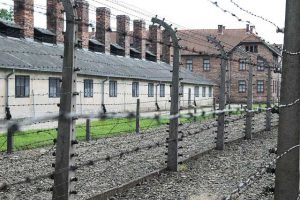
The importance of the “Never Again” message is what prompted me to write my only work of historical fiction. The Auschwitz Escape was born out a trip that I made to the Auschwitz death camp in November 2011. It was not a visit I wanted to make, but it was one I had to make. As I passed the cell blocks and the guard towers and the ovens, I kept trying to think of individuals—the real-life people who endured this torture. It was overwhelming. It was devastating. I can’t imagine anyone walking away from that vile place unchanged.
The Auschwitz Escape was written to keep the truth of the Holocaust in readers’ minds. My hope is that it will give opportunities for discussion between parents and their children—that it will cause a younger generation to do some research informing themselves about what happens when power is unchecked and evil is is allowed to run rampant. With anti-Semitism spiking around the world and violent attacks on synagogues on the rise, “Never Again” is a message that we all need to stand behind.
-Joel
[1] Jacoby, Jeff. “My Hero, My Father.” Jeff Jacoby, Sept. 2000, www.jeffjacoby.com/842/my-hero-my-father.
[2] Jacoby, Jeff. “In 1945, My Father, Starved and Unconscious, Was Mistaken for a Corpse at the Nazi Concentration Camp in Ebensee, Austria. By a Miracle, Someone Realized That He Wasn’t Yet Dead.Last Week, My Father and Mother Welcomed a New Great-Grandchild.!עַם יִשְׂרָאֵל חַי#YomHashoa Pic.twitter.com/tpcz5tRAgx.” Twitter, 2 May 2019, twitter.com/jeff_jacoby/status/1123918058446315521?s=21.
[3] TOI Staff. “German Army ‘Likes’ IDF’s Holocaust Memorial Video.” The Times of Israel, 3 May 2019, www.timesofisrael.com/german-army-likes-idfs-holocaust-memorial-video/.
