




September 26, 2019
Houses of Worship amid Times of Unrest
Houses of Worship amid Times of Unrest
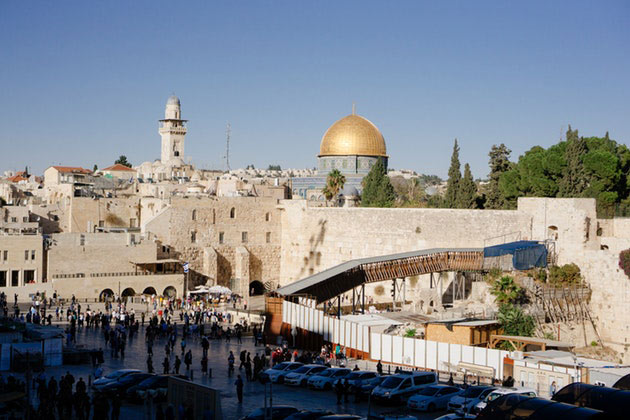
As usual, the Middle East has managed to dominate the front pages of newspapers worldwide over the last few weeks. Saudi oil fields were attacked by Iranian-built drones and cruise missiles, destroying half their daily output. While the repairs have been swift and production is gradually coming back online, the ramifications to the world oil market have been devastating. The question of retaliation still hangs in the air as I write this. What will the Saudis do? How might President Trump strike back? It’s very likely that by the time you read this, these questions will have been answered.
The Israeli elections have also made headlines over the last few days. Will Benjamin Netanyahu and his Likud party form a joint government with Benny Gantz and the Blue & White party? Will there be a shared prime ministry with one man taking the first two years and the other the second two years? Will the backing of Ayman Odeh, leader of the Arab Joint List, propel Gantz into the prime minister position? Will the undecided support of Avigdor Lieberman—a former foreign minister, passionate hater , of Netanyahu, and head of the Yisrael Beiteinu party—place him in his desired position of “king-maker”?
Events are taking place so rapidly in the Middle East right now that it sometimes feels very difficult to keep up with all the twists and turns. Just when you think you have an issue figured out, something new happens and the conclusions that you had just spent so much time developing suddenly shatter to the floor around you. I would love to tell you what coalitions will form in the Israeli elections, but Israeli politics are cutthroat, labyrinthian, and ever-changing. What I write today could be immaterial by tomorrow, and my personal analysis may be completely irrelevant to the situation of the time.

We may not be able to hit a bull’s-eye on a fast-moving target, but one recent piece of news from the Middle East has some permanence to it—an exciting development that rises above the 24-hour news cycle. The United Arab Emirates has announced that construction of its first official synagogue will commence in 2020, completing by 2022. Located in Abu Dhabi on Saadiyat Island, the synagogue will join a mosque and a church as part of a greater multi-faith complex called the Abrahamic Family House.[1] The goal of uniting these three houses of worship together in one location is to create “a community for inter-religious dialogue and exchange, and [for] nurturing the values of peaceful co-existence and acceptance among different beliefs, nationalities and cultures.”[2]
While in the West some might bristle at this show of ecumenism, fearing a watering down of Christian theology, in the Middle East, where religion and politics live hand in hand, this is a very encouraging development. It shows a desire within one nation for peace and friendship between those of differing beliefs. It is also another demonstration of the growing wave of tolerance for religious minorities that has been seen in other nations, such as Egypt, Saudi Arabia, and Israel. In a region dominated by flying missiles, religious division, and violent extremism, seeing this desire for unity is cause for rejoicing. I commend the UAE for taking this step forward, and I hope to see other nations follow its lead.
[1] WAM. “Abu Dhabi: Church, Mosque, Synagogue to Be in One Location.” Gulf News, 21 Sept. 2019, https://gulfnews.com/uae/government/abu-dhabi-church-mosque-synagogue-to-be-in-one-location-1.1569067182292.
[2] Ibid.
