August 19, 2026
Bible Journaling for Beginners: 3 Steps for Creative Annotation
Bible Journaling for Beginners: 3 Steps for Creative Annotation
When silence makes us feel that God is far away, the Bible reminds us that he has promised to never leave us or forsake us. By studying his words, we draw near the throne of grace and dwell in his presence. The question we must ask ourselves is not whether he is present, but instead: Are we making time to notice his presence?
Jeremiah 29:13-14 tells us, “If you look for me wholeheartedly, you will find me. I will be found by you,’ says the Lord.” Even as life presses in on every side, we must seek Christ wholeheartedly.
This is where Bible journaling can be a great tool. By writing down your thoughts and questions while you read a biblical text, you’ll find that Bible journaling not only allows you to discover deeper truths about God’s Word; it also opens the door for greater intentionality in your relationship with Jesus Christ. It’s a rediscovery of the Bible with fresh eyes.
This guide will walk you through everything you need to know to begin Bible journaling—what supplies to gather, how to approach journaling, and how to make these quiet moments applicable to your life.
What You’ll Need

Featuring @nltbible highlighter from @gomr.pen
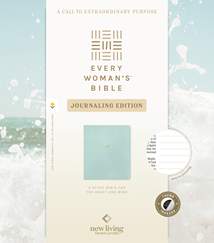
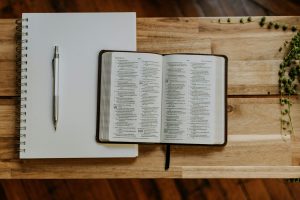
A Journaling Bible—This is the foundation. You can’t journal without a place to write your thoughts! While you can certainly use a Bible and a journal that you already have, there are also journaling Bibles that offer additional perks, including wide margins or specific pages for notes, allowing you to keep every note close to the text you are studying.
Devotional/Reading Plan—A Bible reading plan (a variety can be found online) can also be helpful to direct your reading in the Scriptures but, when in doubt, start at ‘chapter 1’, also called Genesis 1.
Highlighters/Pens—Fine-tip pens are perfect for journaling without allowing ink to bleed through the page. Multicolored highlighters allow you to color code or creatively explore a passage.
A Notepad—The more you explore a passage, the more you will find. When organizing the notes you intend to write in the margins of your Bible, you may find it helpful to keep a notepad handy for additional cross-references or questions you want to research.
A Cup of Coffee or Tea—While technically optional, creating a peaceful moment matters. Choose a drink or an environment that refreshes you.
Much of Bible journaling requires you to discover your own rhythm with a text and tools by exploring a variety of methods. It does not have to be complicated. The goal is not to fill a page with notes but to encounter the God who is seeking communion and a moment of your time.
The Process
Step 1: Read
The process of journaling begins with reading intentionally. Often, we remember stories and images from our children’s Bibles or previous readings. But those adaptations often leave out information important to a truer understanding of the text.
Allow yourself to experience the Word of God by first reading a passage in its entirety, practicing unfamiliarity to discover more deeply a text.
Step 2: Annotate
As you read with intentionality, be on the lookout for the characters, context, and connections that come through in the text. One helpful way to keep track may be to create your own color coordinating system for journaling. For example, you may associate blue with characters, etc. These types of systems help our brain track important details that we may otherwise miss.
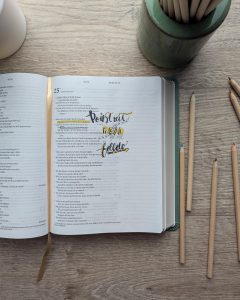
While writing down notes and observations may be the favorite step for some people, it may appear daunting to others. It is important to remember that annotation is not the process by which we analyze the Bible, but rather how we enter it.
If you’re using a Filament-enabled Bible, you have a variety of resources at your fingertips for information discovery and Bible studying. Download the Filament app, scan the page of the Bible you are on, and look through the wealth of study notes, devotions, and worship songs curated for that specific passage.
Characters
The stories of the Bible span thousands of years and include thousands of characters, many of whom often appear in more than one passage. The order of books in the Bible is traditional not always in chronological order, so unless you are following a chronological Bible plan (available online) or using a chronological Bible, you may be moving around a timeline or in and out of a character’s life. The WHO matters in a story, so identifying all the characters mentioned in a chapter will help you with the next section.
Context
The Bible spans the length of human history, but it also gives us information on geographical boundaries, societal rules, and major Biblical events, which can provide a great deal of insight into every chapter.
For example, in the Old Testament, God gave the people of Israel a series of covenants (promises). These first covenants promised the forgiveness of sins through an ongoing and ritualistic system of animal sacrifices. These rituals were engrained into God’s people and formed the basis of their society.
When Jesus died on the cross in the New Testament, a new covenant was established between God and humans, one in which the death of the Son of God, a one-time event, is the only means by which sin could be absolved. No longer would the Israelites have to sacrifice animals, for Jesus’ blood covers every transgression once and for all.
The writer of Hebrews 10:9-10 (NLT) tells us, “Then [Christ] said, ‘Look, I have come to do [God’s] will.’ He cancels the first covenant in order to put the second into effect. For God’s will was for us to be made holy by the sacrifice of the body of Jesus Christ, once for all time.” This new promise brought about change in the lives of all who proclaim Jesus as Lord. After that, Christian traditions focused on the remembrance of Jesus’ sacrifice, which no longer required the blood of sheep and bulls.
Understanding when in history a passage took place is vital to a wholistic and accurate reading of a passage.
Connections
Did you know that the widow mentioned in Ruth 1 is the great grandmother of David in the lineage of Jesus? Or that the life of Jesus is prophesied hundreds of times in the Old Testament, centuries before he would ever be born? These types of connections are valuable to a passage and require a close eye to notice. Many Bibles include cross references which connect verses and topics together. Take time to find these connections across the Bible and discover the different ways in which God has connected every story we read.
Step 3: Review
After exploring a passage’s characters, context, and connections with other passages, how is your understanding of that passage different? Those new insights are precisely the kinds of things you want to write in the margins of your journaling Bible. If you are artistic, explore ways of drawing and journaling that bring the Bible to life for you. Margins are the perfect place for artists to bring their creativity before the Creator.
It’s Time to Begin
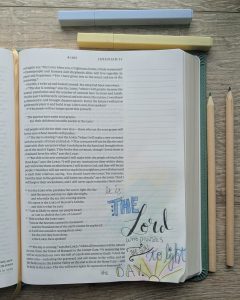
Bible journaling does not require experience with the text or artistic skill. It is a process of discovery. The God who breathed our world into being is not waiting for you to decide on the right technique. He simply waits for you.
Pick up a journal or journaling Bible, turn to a passage, and begin. Think deeply about the words you see, what they mean in their original context, and what they mean for your life today. Use the empty margins to pray and ask, to discover and to seek.
In this rhythm, through this daily discipline, you may find that God was never far away after all. You were just learning to be still enough to notice his presence.